
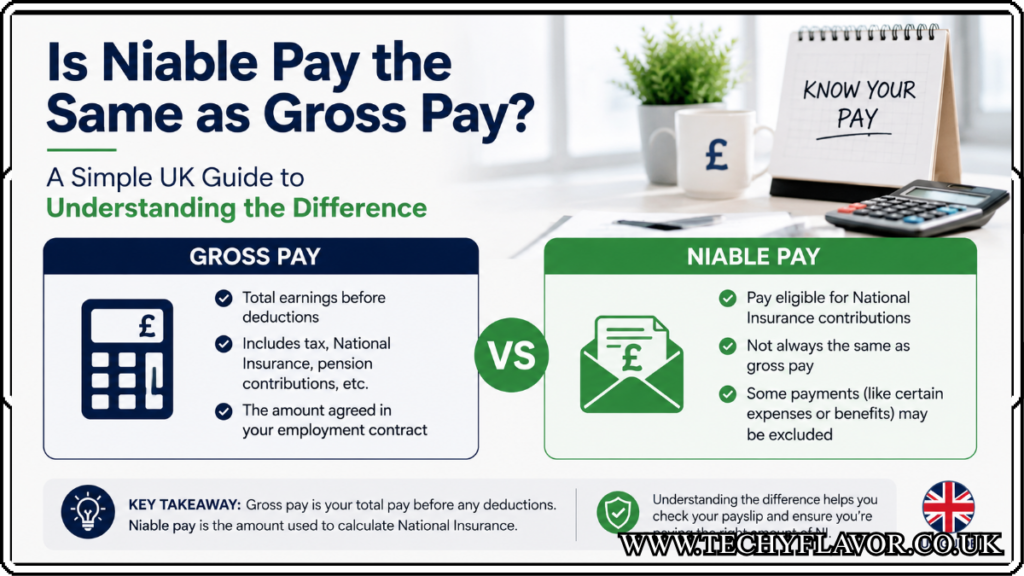

If you’ve been checking your payslip, completing payroll paperwork, or applying for a mortgage, you may have come across the term “niable pay” and wondered whether it means exactly the same thing as gross pay. It’s a common question, especially in the UK where payroll terminology can be confusing.
The short answer is no—is niable pay the same as gross pay? Not always. While the two figures are often similar, they serve different purposes and can differ depending on your pay, benefits, pension contributions, and salary sacrifice arrangements.
This guide explains everything you need to know in plain English. By the end, you’ll understand what niable pay is, how it compares with gross pay, why the numbers sometimes don’t match, and what it means for your National Insurance contributions.
What Is Niable Pay?
Niable pay (sometimes written as NI-able pay) is the amount of your earnings that is subject to National Insurance (NI) contributions.
Employers use this figure to calculate how much National Insurance both you and they need to pay. It isn’t necessarily the total amount you earned before deductions.
The exact amount depends on the rules set by HM Revenue & Customs (HMRC) and whether certain deductions or salary sacrifice arrangements apply.
When people ask, is niable pay the same as gross pay, they’re usually comparing two figures shown on their payslip.
What Is Gross Pay?
Gross pay is your total earnings before any deductions are taken.
Gross pay usually includes:
- Basic salary or wages
- Overtime
- Bonuses
- Commission
- Holiday pay
- Statutory payments where applicable
Before deductions such as Income Tax, National Insurance, pension contributions, student loan repayments, or other authorised deductions, this is the amount you’ve earned.
Is Niable Pay the Same as Gross Pay?
The simple answer is no.
Although they are often identical, is niable pay the same as gross pay depends entirely on your payroll circumstances.
For many employees with straightforward salaries, the figures will match.
However, if you have:
- Salary sacrifice pension schemes
- Salary sacrifice childcare vouchers (where applicable)
- Certain employee benefits
- Other payroll adjustments
then your niable pay may be lower than your gross pay.
This is why the answer to is niable pay the same as gross pay is usually “not necessarily.”
Key Takeaways
- Niable pay is the amount used to calculate National Insurance.
- Gross pay is your total earnings before deductions.
- The figures are often the same but not always.
- Salary sacrifice arrangements commonly create differences.
- Always check your payslip if the figures don’t match.
- Understanding is niable pay the same as gross pay helps you spot payroll errors more easily.
Why Do People Confuse Niable Pay and Gross Pay?
The confusion is understandable because:
- Both figures appear on many payslips.
- They are often identical.
- Payroll software labels vary.
- Many employees never need to compare them.
Someone receiving only a fixed monthly salary with no adjustments may never notice any difference.
That’s why questions like is niable pay the same as gross pay appear so frequently.
When Are They Exactly the Same?
In many cases, they match perfectly.
For example:
Example
Sarah earns:
- Monthly salary: £2,600
- No bonuses
- No salary sacrifice
- Standard pension arrangement
Her:
- Gross Pay: £2,600
- NIable Pay: £2,600
Here, the answer to is niable pay the same as gross pay is yes.
When Are They Different?
There are several situations where they differ.
Salary Sacrifice Pension
Suppose James earns:
- Gross salary: £3,000
- Salary sacrifice pension: £200
His payroll becomes:
- Gross Pay: £3,000
- NIable Pay: £2,800
National Insurance is calculated using £2,800 rather than £3,000.
This is one of the biggest reasons why is niable pay the same as gross pay often has the answer “no.”
Salary Sacrifice for Electric Cars
Some employers offer electric vehicle salary sacrifice schemes.
If part of your salary is exchanged for the vehicle benefit, your NIable earnings may reduce.
Other Salary Sacrifice Benefits
Examples include:
- Additional pension contributions
- Cycle-to-work schemes
- Certain workplace benefits
Depending on how the benefit is structured, NIable pay may change.
Understanding Your Payslip

A UK payslip may include several figures.
You could see:
| Payslip Item | Meaning |
| Gross Pay | Total earnings before deductions |
| Taxable Pay | Earnings used for Income Tax |
| NIable Pay | Earnings used for National Insurance |
| Net Pay | Amount received after deductions |
These numbers don’t always match.
Understanding is niable pay the same as gross pay helps you interpret your payslip correctly.
Why Does NIable Pay Matter?
NIable pay affects:
- National Insurance contributions
- Employer NI costs
- Eligibility for certain state benefits
- National Insurance records
Although a lower NIable pay can reduce NI contributions, it’s worth understanding how salary sacrifice arrangements affect your overall finances.
Does NIable Pay Affect Income Tax?
Not always.
Income Tax and National Insurance follow different rules.
Some deductions reduce:
- Both tax and NI.
Others reduce:
- Tax only.
- NI only.
This is why your taxable pay and NIable pay can also differ.
Another reason people ask is niable pay the same as gross pay is because they notice three different figures on one payslip.
Common Real-Life Example
Imagine Emma earns:
Basic salary: £35,000 annually.
She joins her employer’s salary sacrifice pension scheme.
The sacrifice equals £2,000.
Her figures become:
- Gross contractual salary: £35,000
- NIable Pay: £33,000
National Insurance is calculated using the lower amount.
Meanwhile, her pension contribution grows tax-efficiently.
Is NIable Pay Always Lower Than Gross Pay?
No.
Usually it is:
- The same
- Or lower
It is rarely higher than gross pay because NI calculations generally begin with your earnings before deductions rather than adding extra amounts.
How Employers Calculate NIable Pay
Payroll software automatically considers:
- Salary
- Bonuses
- Overtime
- Salary sacrifice deductions
- Relevant HMRC rules
The software then determines the earnings that are subject to National Insurance.
Employees don’t normally need to calculate this themselves.
Can NIable Pay Affect Mortgage Applications?
Generally, lenders focus on:
- Gross annual salary
- Regular income
- Payslips
- P60 forms
They rarely assess NIable pay directly.
However, if salary sacrifice reduces your reported earnings, some lenders may ask additional questions.
Should You Worry If the Numbers Don’t Match?
Usually not.
Different figures are completely normal.
You should only question them if:
- The difference seems unusually large.
- Your salary has changed unexpectedly.
- Payroll cannot explain the calculation.
If you’re unsure, your employer’s payroll department should explain why the NIable pay differs.
How to Check Your Payslip
A simple checklist:
- Compare gross pay with NIable pay.
- Check for salary sacrifice deductions.
- Review pension contributions.
- Confirm bonuses and overtime.
- Ask payroll if anything looks incorrect.
Doing this every month helps catch payroll mistakes early.
Common Myths
Myth 1: NIable Pay Is Always Gross Pay
False.
As we’ve seen, is niable pay the same as gross pay depends on your payroll circumstances.
Myth 2: Lower NIable Pay Means Missing Salary
False.
A lower NIable figure often reflects salary sacrifice rather than missing wages.
Myth 3: Gross Pay Is Your Take-Home Pay
False.
Gross pay is before deductions.
Net pay is what arrives in your bank account.
Practical Tips for UK Employees
To better understand your earnings:
- Keep every payslip.
- Review payroll changes after pay rises.
- Understand your pension arrangement.
- Learn whether you’re in a salary sacrifice scheme.
- Ask questions if payroll terminology seems unclear.
Knowing the answer to is niable pay the same as gross pay makes it much easier to understand your monthly pay.
Conclusion
So, is niable pay the same as gross pay?
Not necessarily.
Gross pay represents everything you’ve earned before deductions, while NIable pay is specifically the amount used to calculate National Insurance contributions. For many workers, the figures will be identical. For others—particularly those using salary sacrifice pension schemes or certain workplace benefits—they can differ.
Understanding the distinction helps you read your payslip with confidence, spot potential payroll errors, and better understand how your earnings are calculated. If your NIable pay doesn’t match your gross pay, it isn’t automatically a problem—it simply reflects how National Insurance rules apply to your circumstances.
FAQ 1: Is niable pay the same as gross pay on every payslip?
No. Is niable pay the same as gross pay depends on your payroll setup. They are often the same but can differ because of salary sacrifice or other adjustments.
FAQ 2: Why is my NIable pay lower than my gross pay?
Usually because of salary sacrifice arrangements or benefits that reduce the earnings subject to National Insurance.
FAQ 3: Does NIable pay affect my take-home pay?
Indirectly, yes. A lower NIable pay can reduce the National Insurance you pay, although your overall pay depends on other deductions too.
FAQ 4: Can gross pay, taxable pay and NIable pay all be different?
Yes. Each figure is calculated under different rules, so it is perfectly normal for all three amounts to vary.
FAQ 5: Should I contact payroll if my NIable pay is different?
Yes, if you don’t understand the difference. Payroll can explain exactly how your NIable pay has been calculated and whether any salary sacrifice or other adjustments apply.
Read More Blog: